

Understanding Slow Learning: A Guide for Parents
Understanding Slow Learning: A Guide for Parents
One of the greatest concerns many parents carry is the feeling that their child is "learning too slowly." It is a concern that often brings anxiety, frustration, and uncertainty. Parents naturally compare their child's progress with classmates, siblings, or examination expectations and wonder whether something is wrong.
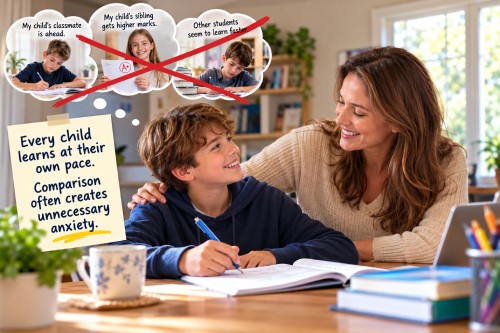
In reality, learning is rarely a race. Every learner develops at a different pace. Some students grasp new ideas quickly but forget them just as quickly. Others require more time, more examples, and more practice before understanding becomes clear. Yet once understanding is established, it often remains firm and dependable.
The speed at which a child learns should never be confused with the child's ability to learn. These are not the same. A student who learns slowly today may, with the right guidance and sufficient time, become a confident and independent learner tomorrow.
Before asking, "Why is my child learning slowly?", it is often more helpful to ask, "What is preventing my child from understanding fully?" That question opens the door to thoughtful teaching, patient learning, and genuine progress.
Learning Is Not a Race
One of the most common misunderstandings about education is the belief that all children should learn at the same speed. In reality, children differ greatly in the time they need to understand new ideas. These differences are a normal part of human learning and should not, by themselves, be a cause for alarm.
Imagine a group of children climbing a mountain. Some climb quickly, some steadily, and others pause frequently before continuing. Although they travel at different speeds, each child is capable of reaching the destination with the right encouragement, guidance, and perseverance. Learning follows a similar pattern. Progress is rarely identical from one learner to another.
Unfortunately, modern education often places great emphasis on keeping pace with a syllabus or preparing for examinations within fixed timelines. Parents naturally become anxious when they see their child progressing more slowly than classmates. Yet speed alone tells us very little about the quality of learning.
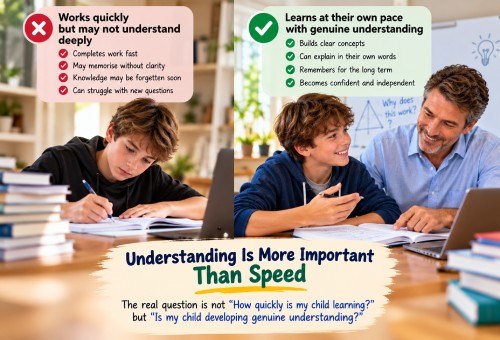
The important question is not, "How quickly is my child learning?" but rather, "Is my child developing genuine understanding?" A learner who takes time to understand deeply often builds stronger and more lasting knowledge than one who moves rapidly without a secure foundation.
Understanding Is More Important Than Speed
Imagine two students learning the same mathematical concept. One student quickly memorises the procedure and is able to answer several questions correctly. The other student takes longer, asks more questions, makes a few mistakes, and needs additional explanations before arriving at the correct answer.
At first glance, the faster learner appears to be doing better. Yet several weeks later, the situation may be very different. If the first student has only memorised a procedure without understanding the underlying idea, much of that knowledge may soon be forgotten. The second student, however, may still remember the concept because genuine understanding has taken root.
This illustrates an important principle of education. Speed and understanding are not the same. A learner may work quickly without understanding deeply, while another may work slowly yet develop knowledge that remains useful for years.
For this reason, educators should never assume that a correct answer always indicates real understanding. Equally, a wrong answer does not always indicate inability. Sometimes it simply reveals that the learner needs another explanation, another example, or a little more time to connect new ideas with existing knowledge.
Parents can also help by changing the questions they ask after a lesson. Instead of asking, "How many questions did you finish today?" they might ask, "What new idea did you understand today?" The second question encourages children to value learning rather than merely completing work.
When understanding becomes the priority, learning gradually becomes more secure. Progress may appear slower at first, but it often becomes stronger, more confident, and more independent in the long run.
Why Some Students Learn More Slowly
There is no single reason why a student may learn more slowly than others. Every learner is unique, and the causes often differ from one child to another. Before drawing conclusions, it is important to understand that slow progress is usually a signal to investigate more carefully, not a reason to lose hope.

One of the most common reasons is a gap in foundational knowledge. Learning is like building a house. Each new idea rests upon ideas that were learned earlier. If one part of the foundation is weak or missing, the learner may struggle with topics that appear to be completely unrelated. The difficulty is often not with the new lesson itself, but with something that should have been understood long before.
Some students also need more examples before a new idea becomes clear. Others learn best when they see a diagram, hear an explanation, solve a practical problem, or discuss the idea with someone else. A method that works well for one learner may not be equally effective for another.
Confidence also plays an important role. A child who has experienced repeated failure may begin to doubt his or her own ability. This lack of confidence can make even familiar tasks seem difficult. As confidence decreases, the learner may hesitate to ask questions or attempt challenging problems, slowing progress even further.
It is therefore important to distinguish between a student who cannot learn and a student who has not yet learned. These are very different situations. In many cases, thoughtful teaching, patient encouragement, and sufficient time can help a learner make steady and meaningful progress.
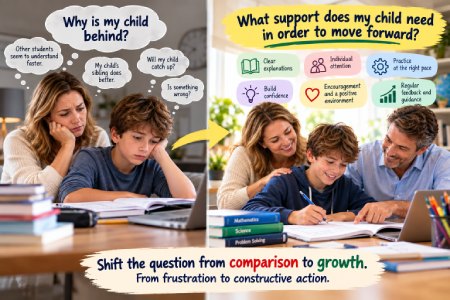
Rather than asking, "Why is my child behind?", it is often more helpful to ask, "What support does my child need in order to move forward?" This question shifts the focus from blame to understanding, from comparison to growth, and from frustration to constructive action.
The Importance of Strong Foundations
Many learning difficulties are not caused by the new topic being taught. They arise because an earlier idea has not been fully understood. Learning is cumulative. Each new concept builds upon knowledge that has already been established. When part of that foundation is weak, later learning naturally becomes more difficult.
This is especially evident in mathematics. A student who has not developed a secure understanding of fractions may later struggle with algebra, percentages, ratios, or probability. The problem is often not the new topic itself, but the missing understanding beneath it. Similar patterns are found in language learning, where difficulties in vocabulary, grammar, or reading comprehension can affect writing and communication.
For this reason, thoughtful educators do not always respond to repeated mistakes by simply giving more practice on the current lesson. Sometimes the wiser approach is to pause, identify the missing foundation, and rebuild it carefully. Although this may appear to slow progress temporarily, it often allows the learner to move forward with much greater confidence and independence.

Parents can support this process by recognising that revisiting earlier concepts is not a sign of failure. It is often a sign of good teaching. Just as a builder strengthens the foundation before adding another floor to a house, an educator strengthens understanding before introducing more complex ideas.
Strong foundations require patience, but they repay that investment throughout a learner's educational journey. Once understanding is secure, future learning becomes easier, more meaningful, and more enjoyable.
The Hidden Cost of Comparison
Comparison is one of the most common responses to a child's academic progress. Parents naturally notice how their child performs in relation to classmates, siblings, relatives, or examination expectations. Although these comparisons are usually made with good intentions, they can sometimes discourage rather than motivate.
Every learner begins the educational journey with different strengths, interests, experiences, and challenges. Comparing two children is like comparing two trees growing in different soil, receiving different amounts of sunlight, and developing at their own natural pace. Healthy growth is measured by steady progress, not by uniform growth.
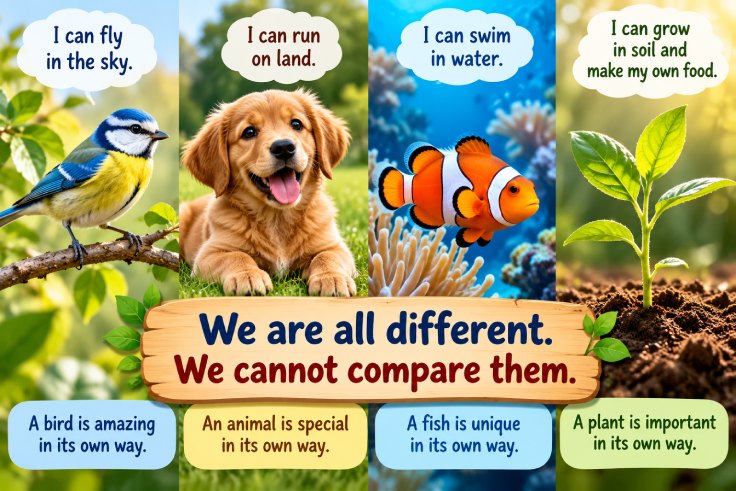
Frequent comparison may unintentionally communicate to a child that personal worth depends upon performing better than someone else. Over time, this can replace the joy of learning with the fear of falling behind. A learner who is constantly compared may become anxious, lose confidence, or begin to avoid challenges in order to escape further disappointment.
A more helpful approach is to compare the child with his or her own previous understanding. Instead of asking, "Why are you not doing as well as your classmate?" parents might ask, "What can you do today that you could not do last month?" This simple change shifts attention from competition to personal growth.
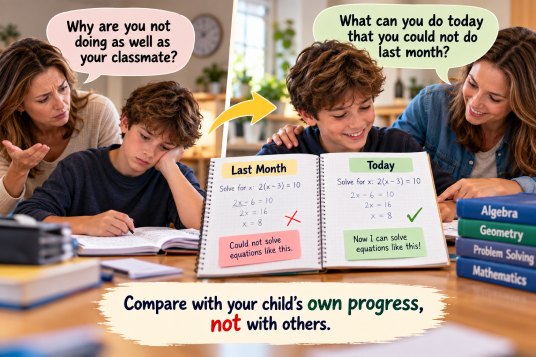
Educators can support the same principle by recognising improvement, perseverance, thoughtful questions, and genuine understanding, rather than praising only the highest marks. When progress is celebrated, learners discover that education is not about proving they are better than others; it is about becoming better than they were yesterday.
Every child deserves the opportunity to grow without carrying the unnecessary burden of constant comparison. Encouragement rooted in understanding helps learners develop confidence, resilience, and a lifelong willingness to learn.
How Parents Can Help at Home
Parents do not need to become teachers in order to support their children's learning. Their most important contribution is not to replace the educator, but to create an environment in which learning is valued, encouraged, and patiently supported.
One of the greatest gifts parents can offer is genuine interest in their child's learning. Simple questions such as, "What new idea did you understand today?" or "Which part of today's lesson made you think the hardest?" encourage children to reflect on understanding rather than merely completing work.
Patience is equally important. Every learner experiences moments of confusion and frustration. When parents respond calmly, children learn that struggling with a difficult idea is a normal part of learning rather than a sign of failure. A patient response often builds confidence more effectively than immediate correction.
Parents can also encourage regular study habits without creating unnecessary pressure. A consistent routine, a quiet place to study, and reasonable expectations often contribute more to long-term success than occasional periods of intense effort.
Mistakes should be viewed as opportunities to learn rather than reasons for criticism. Instead of asking, "Why did you get this wrong?" parents might ask, "What can we learn from this mistake?" Such conversations help children develop resilience and a willingness to keep trying when learning becomes challenging.
Finally, parents should celebrate genuine progress, however small it may seem. A concept understood today, a thoughtful question asked in class, or a problem solved independently represents meaningful growth. When these moments are recognised and appreciated, children gradually develop confidence in their own ability to learn.

The goal of parental support is not to create dependence upon constant supervision, but to help children become increasingly responsible, confident, and independent learners.
How Educators Can Help
An effective educator does much more than explain lessons and assess answers. The educator seeks to understand the learner, recognise individual needs, and create opportunities for steady progress. Good teaching begins not with the textbook, but with the learner standing before the teacher.
When a student struggles repeatedly with a concept, thoughtful educators do not immediately conclude that the learner lacks ability. Instead, they ask important questions. Is there a gap in the learner's foundational knowledge? Would a different explanation, another example, or a visual illustration make the idea clearer? Has the learner understood the language of the question? These questions help educators identify the real obstacle to learning.
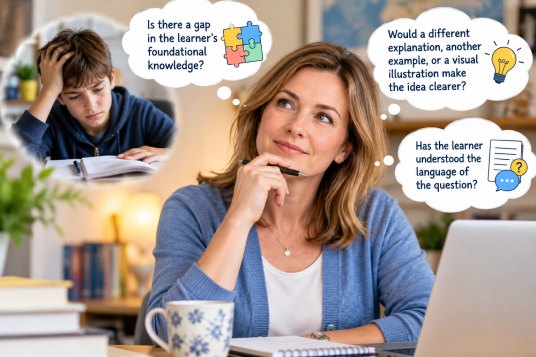
Encouragement is another essential part of good teaching. Learners who are recognised for thoughtful questions, genuine effort, careful reasoning, and steady improvement gradually develop confidence in their own ability to learn. Such confidence becomes a powerful foundation for future learning.
Above all, educators should remember that learning is a journey, not a race. The goal is not merely to complete the syllabus, but to help each learner make meaningful progress. If a student leaves today's lesson understanding one important idea more clearly than before, the lesson has moved the learner forward.

The success of an educator is therefore measured not only by examination results, but also by the confidence, understanding, curiosity, and independence that learners gradually develop under thoughtful guidance.
When a Child Needs Patient Academic Support
When a Year 7 Mathematics student appears to be struggling, looking carefully at the nature of the mistake can sometimes reveal whether the difficulty lies in understanding, applying a procedure, or working too quickly. I explore this idea through some of my own teaching experiences in [Understanding Year 7 Mathematics: What a Wrong Answer Can Tell Us].
A Message of Hope
Every learner's journey is unique. Some children progress rapidly, while others require more time, more guidance, and more encouragement. These differences should never diminish hope. Many successful learners have experienced periods of struggle before developing confidence and understanding.
The combined efforts of thoughtful educators, supportive parents, and determined learners can achieve remarkable progress over time. Growth is not always immediate, and it is not always visible from one day to the next. Yet small improvements, patiently nurtured, often lead to significant long-term success.
Parents should remember that education is not simply about preparing children for the next examination. It is about preparing them for a lifetime of learning, thoughtful decision-making, responsible citizenship, and meaningful contribution to society. A child who learns how to understand, think independently, and persevere through difficulty has gained something far more valuable than examination marks alone.

For educators, every lesson is an opportunity to strengthen understanding, encourage curiosity, and build confidence. For parents, every conversation about learning is an opportunity to communicate patience, trust, and hope. For learners, every challenge is an opportunity to grow a little stronger than before.
Learning is not a race. It is a journey. The purpose of education is not to reach the destination before others, but to continue growing throughout the journey. When understanding becomes the foundation, encouragement becomes the atmosphere, and perseverance becomes the habit, every learner has the opportunity to move forward with confidence.
Many adults who are confident and successful today can remember subjects that once seemed difficult or confusing. What they often remember most clearly is not the difficulty itself, but the patience, perseverance, and encouragement that helped them overcome it. Learning through struggle does not weaken a learner's future; it often develops resilience, determination, and confidence that continue to serve throughout life.
That is why we believe that no learner should ever be defined by today's difficulty. With thoughtful teaching, patient support, and a willingness to keep learning, today's struggle can become tomorrow's strength.
Australian Online Mathematics & Science Tuition for Years 6–10.
Return to the Educational Library